
Published:10/04/2026
The Paperwork Tax: How Logistics Leaders Are Cutting Document Processing Time by 70% (And the Hidden Cost of Waiting)

Discover how moving beyond legacy OCR and leveraging Agentic AI can cut document processing time, moving your project from pilot to production ROI in just 30 days using 7 capabilities that determine success.
Introduction: The Invisible Friction in Your Global Supply Chain
In the competitive landscape of 2026, the most significant threat to your margins isn't necessarily your direct competition — it is the "Paperwork Tax." Despite decades of digitization, the global supply chain remains choked by manual verification and legacy "dumb" OCR systems that can see text but cannot understand intent. According to McKinsey research, these manual bottlenecks still drain up to a full working day per week from employees who are forced to hunt for information across fragmented systems.
We view Intelligent Document Processing (IDP) not as a back-office upgrade, but as a strategic necessity. The market is accelerating, projected to reach $27.62 billion by 2030. Enterprises that fail to adapt are hitting a scalability wall. Conversely, leaders like Careem are already proving the "Agentic" advantage — utilizing AI agents that don't just extract text, but autonomously make decisions, route exceptions, and execute multi-step workflows. By leveraging this tech, they have successfully scaled their transaction volume by 37% without adding a single member to their headcount. In 2026, the ability to scale without proportional labor growth is the only sustainable path to market dominance.
With Oracle’s AI-powered process automation, we have unlocked new opportunities to innovate. Most importantly, it has empowered our colleagues to focus on what they do best — simplifying the lives of our customers.
Qasim Ahmed, Director of Cyber Security Operations & IT Engineering at Careem
The CFO’s Reality Check: Quantifying the "Hidden Costs" of Manual Work
While finance teams meticulously track direct salaries, they often ignore the compounding "hidden tax" of manual document handling. For every $1 spent on direct labor, industry benchmarks confirm that businesses incur an additional $2.30 to $4.70 in hidden costs, ranging from turnover to compliance penalties.
In a high-inflation environment, these costs are no longer manageable — they are terminal.
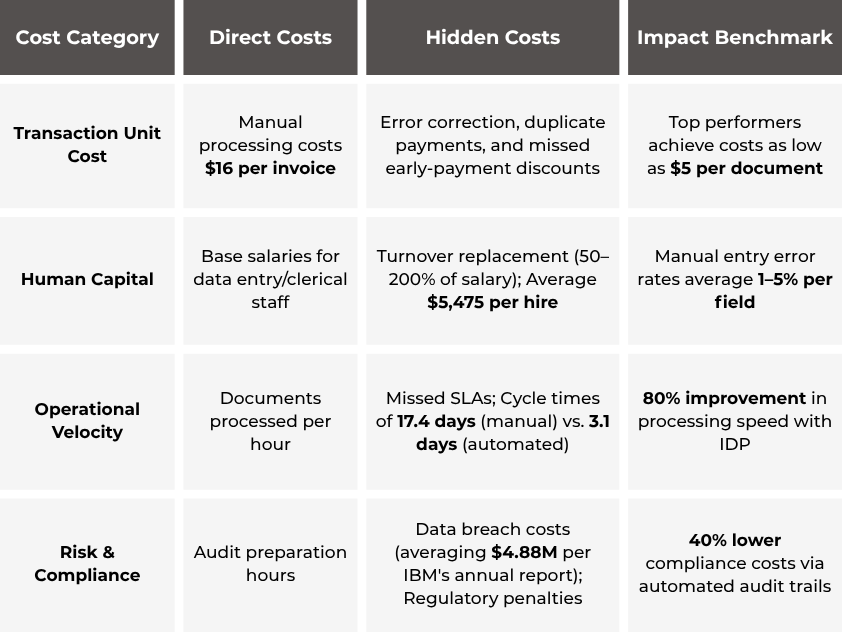
Legacy systems do more than slow you down; they create human capital volatility. Relying on manual "stitching" between systems isn't a management strategy — it's a terminal bottleneck. By 2026, the Paperwork Tax isn't just a cost center; it is a competitive death sentence for late adopters.
Pavel Batashov, Chief Technology Officer at Twelvedevs
Logistics Velocity: Cutting Export BoL Processing by 70%
In the Transportation and Logistics (T&L) sector, document latency is the primary driver of detention fees and customs holds. Processing an Export Bill of Lading (BoL) — with its complex HS codes and freight charges — traditionally requires 15–20 minutes of focused manual effort.
- Velocity gains: Processing times have collapsed from 20 minutes to mere seconds, representing a 70% reduction in cycle time.
- Compliance moats: Modern IDP platforms now handle regional complexities such as the UAE PDPL, South Africa’s POPIA, and the German Supply Chain Due Diligence Act.
Borrowing from Banking: Lessons in Fraud Detection and KYC
While logistics teams are optimizing physical freight, the financial sector has already solved the compliance half of this equation. Logistics COOs can borrow the blueprint for high-stakes automation directly from banking.
Banks utilizing AI-driven IDP report 70% faster loan approvals and 50% improved fraud detection. The strategic bridge for the Logistics COO is simple: the Agentic logic used to flag bank fraud is the exact same logic required to prevent HS Code mismatches in customs. Traditional OCR merely extracts characters; Agentic IDP uses vision models and intelligent orchestration to understand the context of a document.
- KYC logic in logistics: Just as a bank cross-references income against bank deposits to flag inconsistencies, an IDP agent cross-references a packing list against a customs declaration to prevent costly regulatory disputes.
- Regulatory resilience: Banks have reduced compliance costs by 40% using these systems, moving toward a future of "Autonomous Finance" where every transaction is verified in real-time.
The 'Black Box' problem is the final hurdle for the C-suite. This is why we have shifted toward Explainable AI (XAI) and Human-in-the-Loop (HITL) designs. You don't just need a faster system; you need a system that provides a clear audit trail for regulators while allowing your best people to focus on high-value exceptions.
Pavel Batashov, Chief Technology Officer at Twelvedevs
The Multi-Model Tech Stack: Moving Beyond "One-Size-Fits-All" AI
The hallmark of a mature 2026 technical architecture is the rejection of the "single-model" myth. We are moving away from fragile template matching toward a multi-model architecture where vision models understand document structure as a human would.
The 7 capabilities that determine success:
- 95%+ extraction confidence: Achieving high accuracy on production-grade "noisy" documents, not just clean samples.
- Unstructured handling: Processing contracts, handwritten notes, and emails through Agentic OCR that understands complex layouts.
- API-first ecosystem: Native integration into systems like CargoWise, SAP, QuickBooks and Xero.
- Human-in-the-Loop (HITL): Routing low-confidence extractions to experts, ensuring 100% accuracy on mission-critical data.
- Multi-format & multilingual: Handling everything from PDFs to specialized medical formats, including Arabic-English support for Middle Eastern markets.
- Model specificity: Using local self-hosted AI models for HIPAA-compliant medical summaries, while leveraging Gemini for narrative case summaries.
- Self-learning loops: Systems that refine their accuracy based on human corrections in real-time.
We have baked these exact principles into the foundation of AutoFill — our universal, self-hosted microservice that automates data extraction from PDFs, scans, and photos. Instantly populate your TMS, ERP, or WMS with structured data. By orchestrating specialized models for vision and extraction, we’ve moved past the limitations of traditional OCR to deliver true, structured automation. Try the demo.
The 30-Day Blueprint: From Pilot to Production ROI
Modern IDP implementation has compressed from years to weeks. The goal is to secure early wins with high-volume, standardized documents (like invoices) before tackling complex edge cases.
Day 1-2 (Discovery & Baseline):
- Map current document workflows and quantify baseline labor costs.
- Establish pilot data sets (aim for 500+ documents/month).
Day 3-9 (Pilot & HITL Validation):
- Go live with the first workflow using Human-in-the-Loop (HITL) as a risk-mitigation strategy.
- Achieve 20-40% time reduction through initial model tuning.
Day 10-30 (Scale & ROI):
- Push to full production across multiple document types targeting a 60-80% volume reduction in manual handling.
- Realize a 30-200% first-year ROI driven by labor reallocation and error elimination.
Conclusion: The Compound Gap of Delayed Adoption
The divide between the automated and the manual is no longer a slope; it is a chasm. Best-in-class performers have compressed their document cycle times to 3 days, while manual teams remain anchored to a 17-day average.
As we move toward a future defined by self-optimizing supply chains, the cost of waiting is a compounding liability. If your current cost structure relies on manual entry, you are absorbing preventable financial risk that your competitors have already solved. As industry analysts universally conclude: adopting AI-powered document automation is no longer just an option — it is a baseline necessity for survival in modern logistics and finance.
Ask yourself: can your organization survive the compound gap between your manual workflows and your competitors' automated ones?
Take Action: Don't let the Paperwork Tax erode another quarter of your margins.