
Scalable last-mile logistics dispatcher platform
Development of a scalable dispatcher platform and high-performance backend architecture to replace a restrictive legacy monolith for a North American last-mile logistics provider
Client
A leading service provider operating in the highly competitive North American logistics landscape. The company orchestrates a complex 3-way delivery cycle (customers, drivers, and operators) for high-volume enterprise partners like Walmart and ezCater
Business challenges
- High onboarding costs for new dispatchers due to poor UX, chaotic system behavior, and fragmented data
- Operational scalability hard-capped at 2,000 daily orders due to manual workflows and extreme system latency
- Unpredictable scaling costs: system capacity could only be maintained by continuously purchasing expensive AWS server power, rather than through code optimization
- System fragility caused by an undocumented legacy monolith where all business logic was heavily reliant on the "tribal knowledge" of a single developer
Our solutions
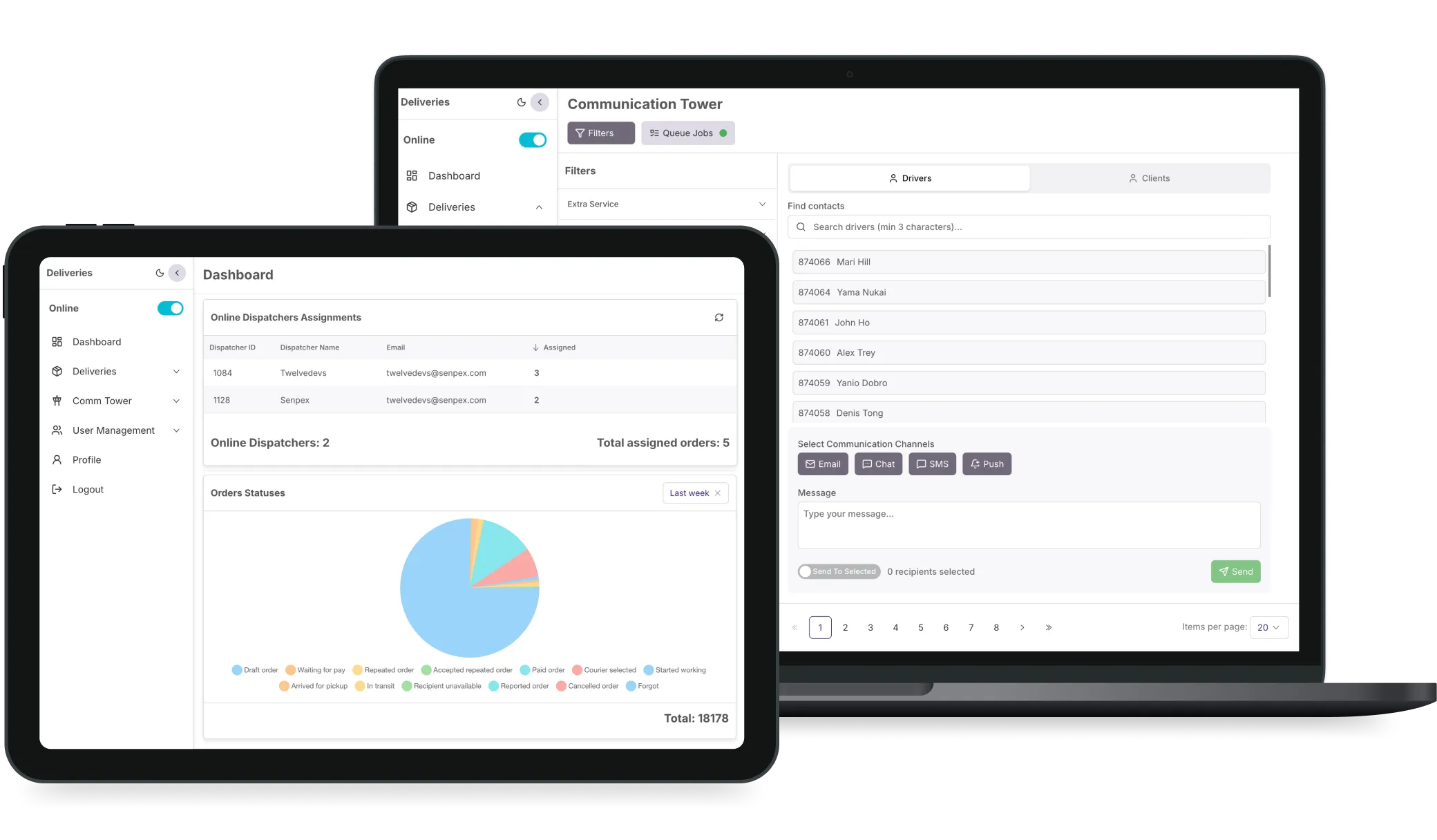
- High-performance MVP Dispatcher Portal with an intuitive UI
- Automated Dispatcher Assignment engine for balanced workload distribution
- Configurable "Attention Required" triggers for proactive SLA compliance
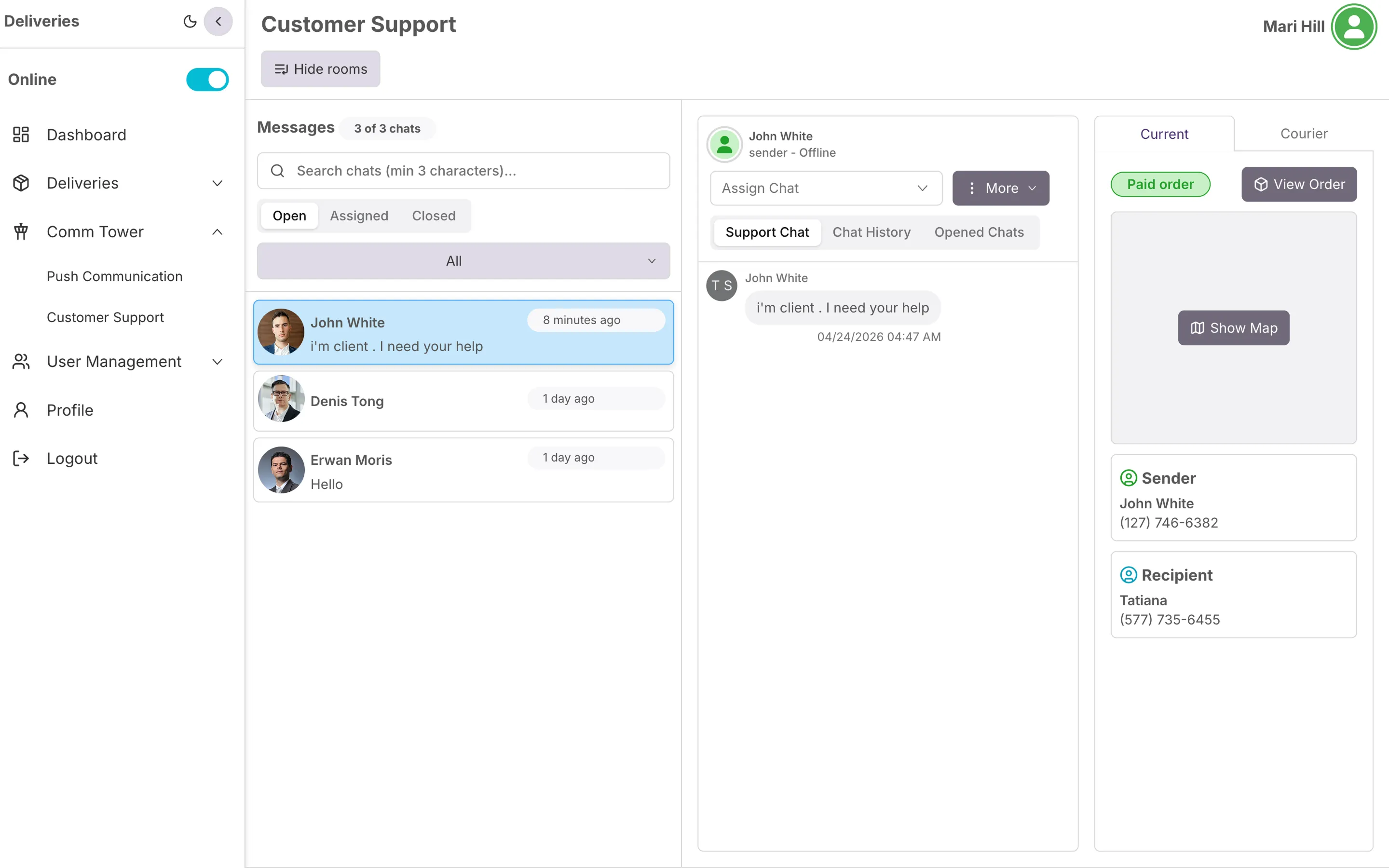
- Total decoupling and re-engineering of the internal Chat Module
- "Parallel Evolution" bridging architecture to connect modern systems with legacy databases
Project implementation
The project initiated with a rigorous discovery and reverse-engineering phase of the existing PHP codebase. Because no formal documentation existed, our team had to deconstruct the legacy code to extract latent business logic. Many critical, partner-specific requirements (for clients like Walmart and OneRail) had to be uncovered directly during testing.
To address the immediate operational bottlenecks without disrupting live business, we executed a "Parallel Evolution" strategy. We developed the MVP Dispatcher Portal using a modern TypeScript stack while maintaining a direct, fragile bridge to the existing MySQL database, which continued to handle untouchable financial logic.
A key technical challenge was the total rewrite of the Chat Module. Originally built ad-hoc to "just work," it required complete reverse engineering to integrate seamlessly into the new UI. This module not only improved operational performance and eliminated dispatcher "chat-hopping," but also served as the architectural blueprint for systematically dismantling the remaining legacy monolith.
Technology stack
- TypeScript / Node.js 24
- React 18 / MobX / Rsuite
- Vite
- Fastify / Knex
- PostgreSQL / MySQL
- Jest
- JWT / Helmet / TypeBox
Key activities
Results
The delivery of the 6-month MVP marked the successful completion of the most high-risk phase of digital transformation, achieving the following results:
- Resolved critical data filtering bottlenecks, making the system technically capable of supporting the 5x growth target (10,000 orders/day) without relying on brute-force AWS server upgrades
- Significantly reduced dispatcher onboarding time by replacing chaotic legacy interfaces with an intuitive, centralized workspace
- Transitioned the architecture from high-risk structural entropy to clarity, replacing undocumented logic with a secure, easily maintainable TypeScript environment
- Improved SLA compliance for enterprise partners by implementing automated workload balancing and proactive "Attention Required" alerts
